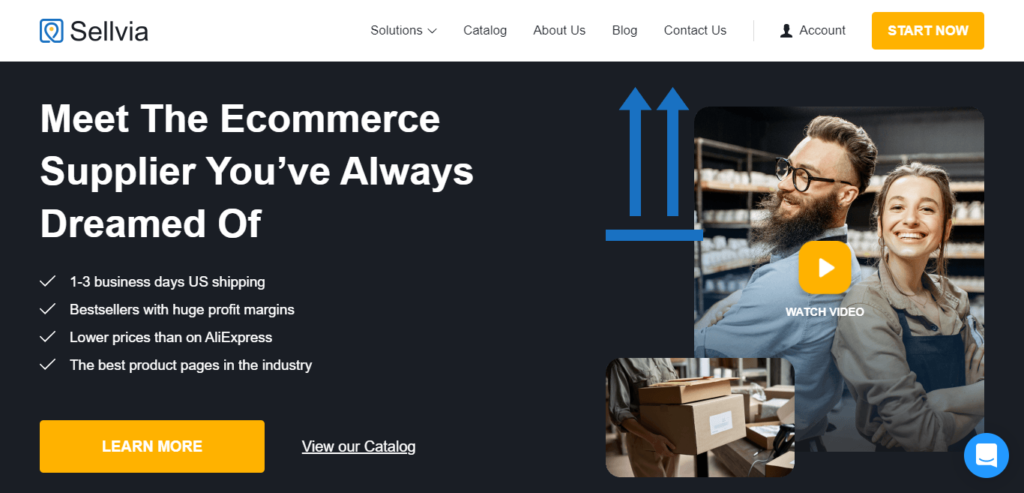
If you're looking into Sellvia, you're in a vortex of conflicting opinions. There are two reviews that call it a 'game-changing miracle' and another one declares it a'subscription trap'. It's not the case with random noise. Some people are reviewing the promises of marketing while others look at the nitty-gritty of running a small-scale business on platforms. In order to find the signal within this chaos, stop looking for an absolute "good or bad" and instead, begin looking for patterns that are apparent across hundreds of different user experiences. These patterns aren't revealing a fraud, but a system with friction points that may suit your way of working or work against it.
The most significant difference between reviews lies in the Onboarding Experience versus the Operational Reality. When they are in the trial phase, new users are often amazed by the elegant dashboard and catalog of products from the US and the promise of 2-day shipping. They write glowing reviews. They are evaluating the potential and the concept of the possibility of a solution to logistics. This is an "honeymoon review". The contrasting, more valuable reviews come from users 3 to 6 months into. They review the process. There is a pattern that is that praise for automation and shipping speed are often masked by two recurring problems ghost inventory and quality lottery. Many popular items could and do disappear from stock without real-time updates, leading to cancellation of orders and unhappy customers. Furthermore, while many products are good, the variance in quality and price from Sellvia's supplier network results in the "cheap look" of some items becomes an immediate threat to your store's reputation as well as rates of refund. These aren’t bugs, they’re an inherent feature of the third-party fulfillment model.
The Subscription vs. Scalability debate is a second critical pattern that appears in the review tapestry. Monthly fees are frequently a cause for contention but they're not often critiqued. Most people consider that it's a business model. The more critical criticisms are based on the inflexibility of the value. Entrepreneurs who've scaled up to 20-50, or 100+ orders per month are prone to the same frustration. The platform isn't necessarily more efficient or cost-effective at scale. You don't receive any additional leverage, more precise pricing, or more efficient analysis. Your profit per order remains squeezed between their wholesale cost as well as your marketing budget and the fixed monthly fee. This is what causes the "success wall" in reviews. Sellvia has been praised for its amazing launchpad, but many sellers have reported hitting a brick wall and feeling the need to either "graduate" into building connections directly with US wholesalers, or keep inventory to improve their margins. Sellvia is best suited for launching and running an enterprise, not taking over the entire market.
The most fascinating reviews do not refer to Sellvia more so the function played by the founder. Reviews that are positive do not necessarily about Sellvia. These positive reviews have a consistent formula. "I utilized Sellvia's shipping service AND I built an incredible TikTok channel," "AND, I mastered my email marketing sequences." The negative reviews often follow the opposite formula. "I have plugged Sellvia into Facebook and ended up losing some money." This is a pattern that reveals Sellvia's true nature as a logistics tool, and not a company partner. It handles the logistics (a significant win) but also casts a dark light on the other aspects: Marketing creativity, product research branding, customer service and branding. Sellvia's reviews provide the facts It has succeeded in solving a piece of the puzzle. Now you are left with the tougher pieces to work out.
The final step is to decode Sellvia's reviews. is a matter of reading between expectations of humans. The platform delivers impressively on its primary promise: fast, automated US fulfillment for dropshippers. Negative reviews are almost always marked by patterns that reveal the main flaws that are causing the lack of transparency in inventory, the uniformity of products and constraints on scaling. The "most" positive reviews shouldn't be the sole determinant in your decision. It should be a diagnosis that asks: Are you prepared to handle the risk of inventory? Do you have a reputation that is strong enough to stand up to the occasional bad product? Are you looking to operate a stable, automated small business, or to grow a well-known brand? The reviews won't tell whether you should continue or not. Instead, they'll reveal the results of the stress test. Your job is to see whether your business plan is able to withstand those specific stresses. The answer isn't contained in a single testimonial; it's in the recurring themes that define the actual conditions of your platform. Have a look at the best sellvia reviews for blog advice including sellvia dropshipping reviews, sellvia pricing, sell via amazon, sellvia photos, sellvia pricing, sellvia phone number, sellvia store, sellvia contact number, sellvia phone number, sellvia scam and more, including sellvia reviews with sellvia pro, sellvia custom store, sellvia premium products, sellvia product catalog, sellvia cost, sellvia store, sellvia dropshipping reviews, selvia dropshipping reviews, sellvia contact number and selvia dropshipping.
Sellvia's Scale Ceiling: When Automation Becomes An Enclosure
Sellvia offers a highly effective solution to any aspiring businessperson. It is a turnkey dropshipping solution that will eliminate the problems of logistics. It's a dependable easy and clean way to get into e-commerce. It streamlines the complicated dance that occurs between supplier, warehouse and customer. The automation is a service and, for retailers having their first 100 customers it's a great feeling. A subtle yet important shift occurs as your company develops and expands. The very systems that freed you begin to define your boundaries. Sellvia's most potent feature that integrates control without the need for manual intervention, slowly reveals its flaws: its inherent shortcomings in regards to control. Understanding this change will allow you to decide whether Sellvia is the best choice for your primary platform or an extremely efficient launchpad.
The ceiling is composed of two dimensions. The second is Economic Rigidity. Sellvia's model is built on simplicity: a monthly cost grants you access to its catalog and its fulfillment network. This model is very effective for small quantities. The simplicity of this approach doesn't change with the success. If you are able to fulfill thousands of orders, your cost structure remains the same. The leverage you earn to negotiate better wholesale rates on your most popular items is gone. You are unable to take advantage of the economies-of-scale that you generate, and your per unit profit margin is set. At first, it was a minor issue that was a minor issue, the subscription cost has risen to the level of a non-existent expense. But your inability to improve the fundamental Cost of Goods Sold becomes a major problem. The growth you experience does not happen by enhancing your unit's economy, it's linear. The way to increase your profits is by finding more customers, not creating more revenue per customer on the demand side. This is a disadvantage for the founders who are incredibly ambitious.
This economic rigidity is in tandem with the Strategic Sameness. Control of your product is totally restricted. Sellvia must be involved in order for you to make modifications or enhancements to the bestseller. It is not your job to create your brand's image, you are just an online retailer. This makes it incredibly difficult to build a strong brand. You're not competing with other Shopify users, but you're also competing against all Sellvia user who sells the identical product in the same warehouse. Thus, you have to create your own competitive moat--in marketing, in customer service, and in content. However, while it's powerful, it confines you to one field of battle. The platform controls all of these levers but they are not yours. Your brand's destiny is outsourced.
Platform Dependency becomes the pivotal factor. Sellvia effectively minimizes risk to operations, but while doing it is centralizing a new form of risk that is strategic. Your entire company depends on their software, suppliers inventory, and fulfillment performance. You are not able to instantly control or solve a policy change or price hike, or interruption to their primary supplier. It is not possible to find a backup provider. This is the kind of dependence you receive in exchange for automation. For a lifestyle business seeking stable, managed income it is a reasonable and worthwhile trade. If a business owner wants to create an asset that is worth and marketable--a brand that has intellectual property owned by a proprietary supply networks and software that can be transferred--this dependence is a major problem. The core functions of a totally third-party business are often not owned by the company. This makes it worth less than it's sales would be.
Therefore, the ultimate issue Sellvia asks isn't about the creation of a company however, it is about how to define its ultimate form. It is an essential tool to achieve efficient sufficiency, as it permits you to operate a profitable business with minimal headaches. It's not the best choice for an exponential control -- a dominant, profitable brand, where all elements of value are controlled by the founder from the design of the product and profits to customer information. Smart users are aware of this paradox from the beginning. Sellvia's powerful engine lets them validate their markets, generate cash and gain expertise in marketing and customer acquisition. But they do so with an eye on the horizon, knowing that the skills they master on the platform--particularly in driving demand--are the very skills they will need if they ever choose to step beyond its walls, negotiate directly with US wholesalers, or produce their own products, reclaiming control for the sake of scale. Sellvia isn't a prison unless you're looking to fly in directions it wasn't made for. To plan your flight first, you need to know the goal it was made to serve. Follow the most popular online business ideas for more info including selvia dropshipping, sellvia dropshipping, sellvia dropshipping reviews, sellvia marketing, sellvia reddit, sellvia customer service, sellvia warehouse, sellvia stores, selvia dropshipping reviews, sellvia profit and more.